

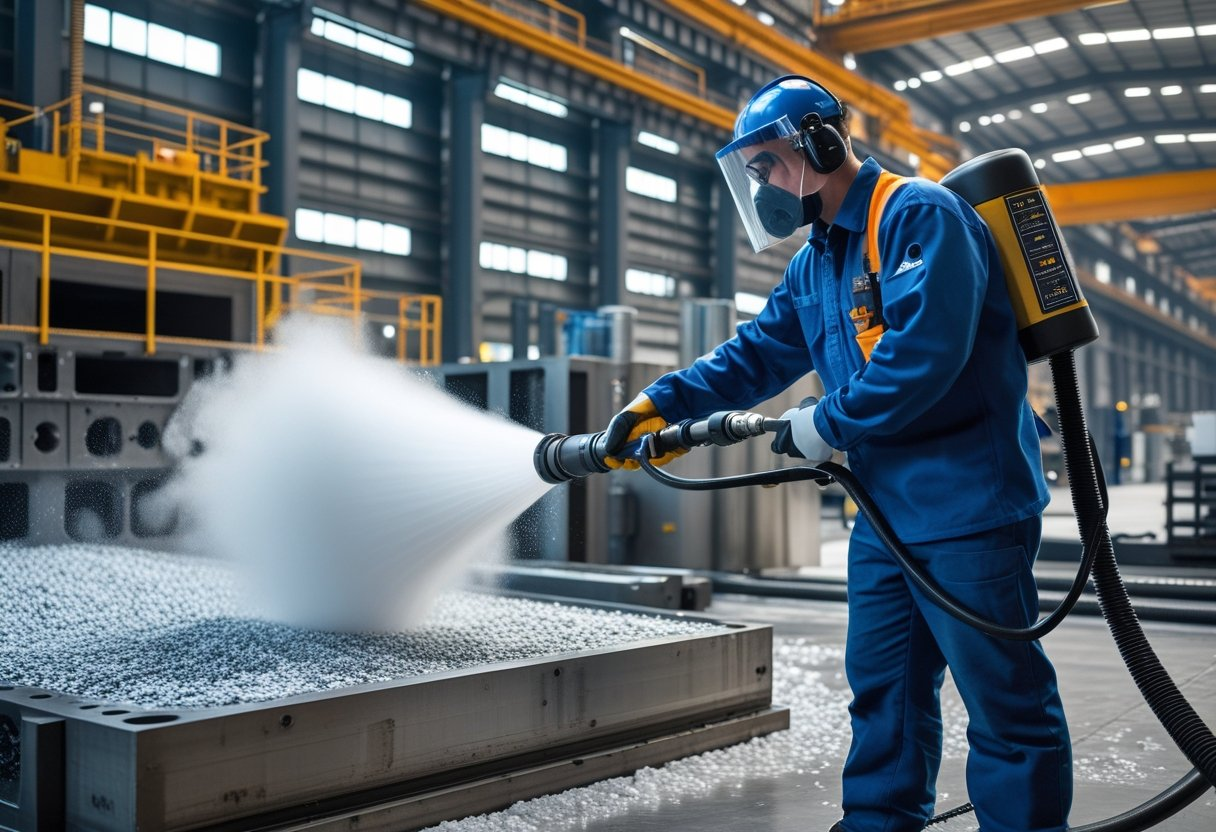
In foundry and manufacturing environments, residue buildup from slag, weld spatter, and heat-treated surfaces can disrupt production efficiency and increase maintenance downtime. Traditional abrasive, wet, or chemical cleaning methods may introduce secondary waste, moisture, or surface wear—creating additional operational challenges. As an industrial dry ice blasting equipment manufacturer, Nu-Ice Dry Ice Blasting Systems™ provides a precision-based solution designed to address these concerns. The dry ice blasting foundry process utilizes a dry ice blasting method that cleans without abrasive media or added chemicals, making it suitable for sensitive tooling and production equipment. This dry ice blasting manufacturing approach supports residue removal while helping facilities maintain operational continuity.
Dry ice blasting is an industrial cleaning process that uses solid carbon dioxide (CO₂) pellets propelled by compressed air to remove contaminants from surfaces. The system accelerates dry ice pellets through a hose and nozzle, directing them at the targeted area. Upon impact, the pellets loosen contaminants and immediately sublimate—transitioning from solid to gas—without leaving behind liquid residue. Because the dry ice converts directly into CO₂ gas, there is no secondary blasting media to collect or dispose of. This cleaning approach is designed for use on production equipment, tooling, and surfaces where minimizing downtime and avoiding additional waste streams are operational priorities.
Kinetic Impact
Dry ice pellets are accelerated using compressed air and directed at contaminated surfaces. The velocity of the pellets helps dislodge buildup such as slag, coatings, or production residue without the use of abrasive grit.
Thermal Shock
When dry ice contacts a warmer surface, the temperature difference contributes to weakening the bond between the contaminant and the substrate. This rapid cooling effect assists in loosening adhered material.
Sublimation Expansion
Upon impact, dry ice sublimates from solid to gas. The rapid expansion of CO₂ gas at the surface helps lift and separate contaminants, supporting effective cleaning without generating secondary media waste.
A dry ice blasting system consists of several key components that work together to deliver cleaning performance.
Air Compressor
The air compressor supplies the compressed air required to accelerate dry ice pellets through the system and toward the surface being cleaned.
Dry Ice Hopper
The hopper stores solid CO₂ pellets prior to blasting. It is designed to feed pellets into the system in a controlled manner.
Metering System
The metering system regulates the amount of dry ice delivered into the airflow, allowing operators to manage pellet flow based on cleaning requirements.
Hose and Nozzle
The hose transports the air and pellets, while the nozzle directs and focuses the stream onto the target surface.
Nu-Ice Dry Ice Blasting™ is a U.S.-based manufacturer of industrial dry ice blasting equipment, serving foundry, manufacturing, and heavy industry applications. Founded in 1995, the company designs and manufactures its systems in the United States. Nu-Ice equipment is engineered to support industrial cleaning processes involving residue removal from production equipment, tooling, molds, and other operational surfaces. The company provides systems designed for use in environments where minimizing disassembly and reducing secondary waste are operational considerations. Through its dry ice blasting manufacturing equipment, Nu-Ice supports applications that require controlled delivery of solid CO₂ pellets using compressed air. Its equipment portfolio reflects an emphasis on industrial-grade construction and compatibility with standard compressed air infrastructure.
Nu-Ice dry ice blasting systems include several integrated components designed to support consistent operation in industrial settings.
Blasting Gun and Interchangeable Nozzles
The blasting gun directs the compressed air and dry ice stream toward the target surface. Interchangeable nozzle options allow operators to adjust the spray pattern and focus based on the cleaning application.
Integrated Moisture Separator
An integrated moisture separator is incorporated into the system to help remove moisture from the compressed air supply. This supports stable pellet flow and system operation.
Aftercooler
The aftercooler reduces the temperature of compressed air before it enters the blasting system. Cooling the air assists in maintaining appropriate operating conditions for dry ice delivery within the equipment.
Nu-Ice dry ice blasting systems are designed with industrial-scale operating parameters. Equipment dimensions and overall weight vary by configuration, with systems built for portability within plant environments. Hopper capacity is designed to hold a supply of dry ice pellets sufficient for continuous cleaning cycles before refilling. Operating air flow requirements fall within a defined range compatible with industrial air compressors, and pressure settings are adjustable within specified limits to accommodate different cleaning applications. Dry ice consumption rates vary depending on airflow, pressure, and metering settings. These technical specifications enable operators to align system performance with application requirements while maintaining compatibility with existing compressed air infrastructure commonly found in manufacturing facilities.
Preparation and Setup
The process begins by connecting the dry ice blasting unit to an appropriate compressed air supply. Dry ice pellets are loaded into the hopper, and airflow and pressure settings are adjusted according to application requirements. The integrated moisture separator and aftercooler support preparation of the compressed air prior to operation.
Safety Requirements
Operators are expected to follow standard industrial safety procedures, including the use of appropriate personal protective equipment and ensuring adequate ventilation when working with CO₂.
Typical Workflow Steps
Once activated, compressed air propels dry ice pellets through the hose and blasting gun toward the target surface. The operator directs the nozzle across the area being cleaned in a controlled manner, adjusting pellet flow and air pressure as needed throughout the process.
Nu-Ice dry ice blasting equipment is used across a range of industrial and commercial environments.
Manufacturing and Production
In manufacturing facilities, systems are applied to production equipment, molds, tooling, conveyors, and processing components where residue buildup occurs during regular operations.
Food Processing and Sanitation
In food production environments, dry ice blasting is utilized for cleaning processing equipment and production lines, where a dry cleaning method is required and moisture introduction is limited.
Historical Restoration and Delicate Surfaces
The equipment is also used in restoration projects involving delicate substrates, including historical structures and architectural materials where controlled surface interaction is required.
Automotive, Aerospace, Electrical, and Specialty Cleaning
Applications extend to automotive and aerospace manufacturing, electrical components, and specialty industrial equipment where precision cleaning of machinery and surfaces is part of maintenance or production workflows.
Dry ice blasting is a dry, non-abrasive cleaning process that does not introduce water or chemical solvents into the cleaning area. Because dry ice sublimates upon impact, there is no secondary blasting media to collect after operation. This dry ice blasting method reduces the need for disposal of additional cleaning materials and supports environments where limiting residual waste is a consideration. The process relies on solid CO₂ pellets and compressed air, requiring appropriate ventilation and standard industrial handling procedures. As a dry ice blasting foundry and industrial cleaning approach, it is designed for use on operational equipment where minimizing moisture and surface abrasion is part of maintenance planning.
Nu-Ice dry ice blasting systems are supported by accessory components designed for integration into industrial environments. Interchangeable nozzles and hose configurations allow operators to adapt the blasting stream to specific surface areas and equipment layouts. Systems are designed to connect to standard industrial compressed air supplies, with integrated moisture separators and aftercoolers assisting in preparing the air before it enters the unit. Proper dry ice storage in insulated containers is required to manage sublimation prior to use. Routine maintenance includes inspection of hoses, fittings, and air supply components to support consistent operation within manufacturing settings.
Frequently Asked Questions (FAQs)
What is dry ice blasting?
Dry ice blasting is a cleaning process that uses solid CO₂ pellets accelerated by compressed air to remove contaminants from surfaces. The pellets sublimate upon impact, transitioning directly from solid to gas without leaving liquid residue.
What equipment is required to operate a dry ice blasting system?
Operation requires a dry ice blasting unit, a compatible compressed air supply, dry ice pellets, and appropriate hose and nozzle assemblies. Integrated components such as moisture separators and aftercoolers support air preparation within the system.
What safety considerations apply to dry ice blasting?
Operators should follow standard industrial safety practices, including the use of personal protective equipment and ensuring adequate ventilation when working with CO₂. Proper handling and storage of dry ice are also required.
What infrastructure is needed in a facility?
Facilities must have access to a compressed air system capable of meeting airflow and pressure requirements specified for the blasting equipment. Adequate space for operation and ventilation should also be considered.
How does dry ice blasting compare to abrasive cleaning methods?
Unlike abrasive media blasting, dry ice blasting does not use grit or sand as a blasting material. The solid CO₂ pellets sublimate upon impact, meaning there is no additional blasting media remaining after the process.
Is dry ice blasting environmentally responsible?
The process uses reclaimed carbon dioxide formed into solid pellets. Because the dry ice sublimates and does not introduce water or chemical solvents, it does not generate secondary blasting waste material.
Can dry ice blasting be used on sensitive equipment?
The process is designed for use on various industrial surfaces, including production equipment and components where moisture or abrasive materials may not be appropriate. Application suitability depends on specific operational conditions.
Nu-Ice Dry Ice Blasting™ continues to manufacture industrial dry ice blasting equipment in the United States, serving foundry, manufacturing, food processing, automotive, aerospace, and restoration sectors. Since its founding in 1995, the company has focused on the development of systems designed to operate with standard compressed air infrastructure and solid CO₂ pellets for industrial cleaning applications. Its equipment portfolio reflects integration of core system components such as moisture separation, aftercooling, metered pellet delivery, and interchangeable nozzles to support varied operational requirements. By maintaining domestic manufacturing and application-focused system design, Nu-Ice provides industrial facilities with equipment intended for routine maintenance, production support, and surface preparation across a range of commercial and heavy-duty environments.