
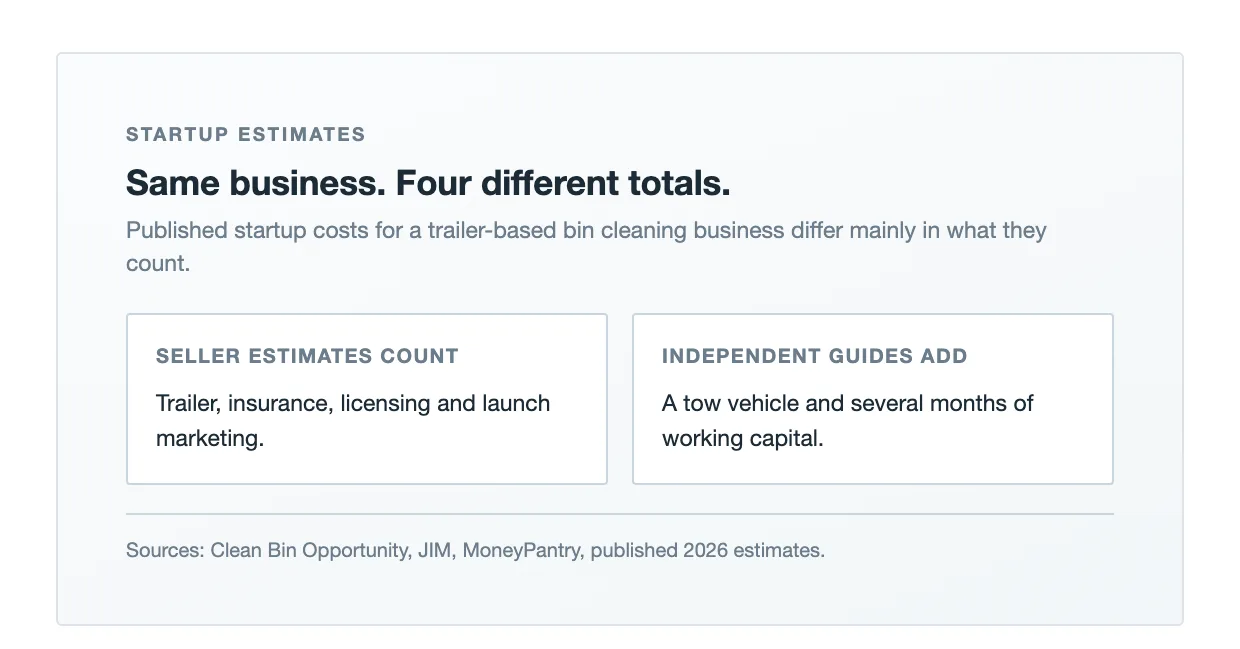


Published startup estimates for trash bin cleaning range from about $30,000 to nearly $160,000. The gap mostly depends on what each source leaves out.
Trailer-based service businesses are sold on a simple idea. Buy one piece of equipment, hitch it to a truck, and start a route. Curbside trash bin cleaning is a clear example: a trailer with a water tank, a heater, and a lift washes residential garbage cans at the curb and bills the household on a subscription.
Anyone researching the business quickly finds one number, then another. Published startup totals for the same business range from roughly $30,000 to almost $160,000. That is not a rounding difference. It is a five-fold spread.
Reading the estimates side by side shows the sources don’t disagree on prices. They are counting different things.
Four published totals for the same business
Clean Bin Opportunity, a site run by a trailer manufacturer, puts the startup cost at about $30,600. That figure covers the trailer, insurance, licensing, and launch marketing.
JIM, a payments company that publishes guides for small operators, gives a range of $25,000 to $50,000, built around a used truck and six months of working capital. MoneyPantry, a personal finance site, puts the total at $35,000 to $80,000, including the trailer, a vehicle, and a $15,000 to $30,000 cash reserve.
At the top, the Bin Blasters franchise lists a total investment of $83,050 to $158,900 in its 2026 disclosure document, as summarized by Franchise Depth. That range includes the franchise fee, equipment, and opening costs.
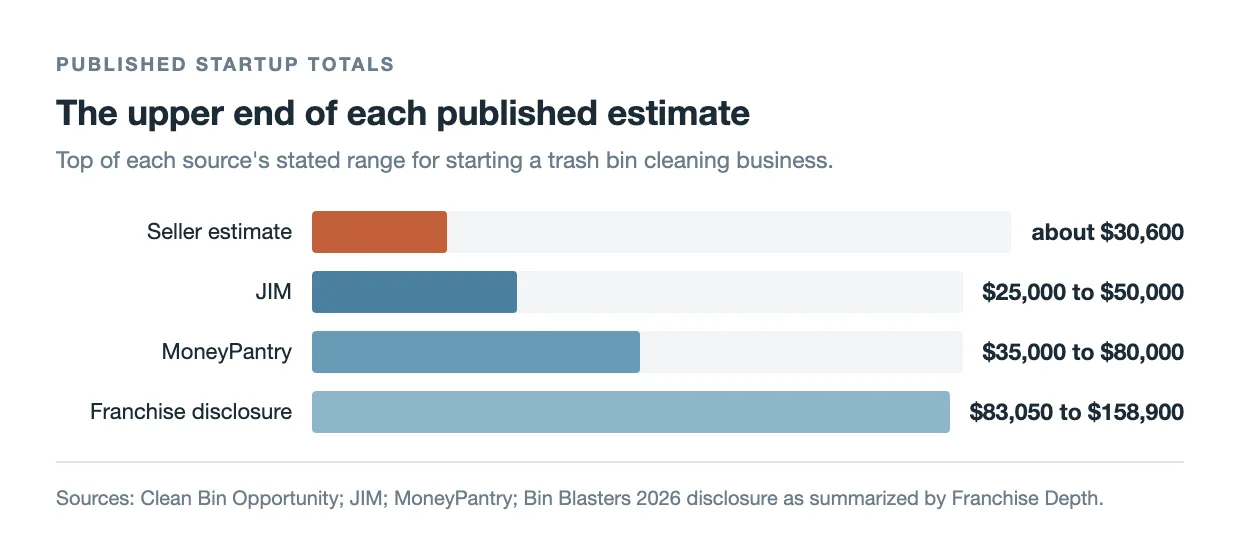
The same business, costed four ways.
What the lowest number leaves out
The lowest estimate comes from a company that sells the equipment, and it stops at the items closest to the equipment. Two things are missing: something to pull the trailer, and money to live on while the route fills.
Neither omission is unusual. A seller’s estimate answers the question the seller is asked: what it costs to put the product into service. A buyer who already owns a suitable truck and has savings may find the figure accurate.
For a buyer starting from nothing, the independent guides are closer to the real total, because they count the vehicle and the reserve. That is the difference between about $30,000 and a range that runs to $80,000.
The equipment itself
The trailer is the largest single line. The Bin Trailer, one manufacturer that publishes its prices, listed its entry cold-water model at $29,999 and its hot-water model at $45,999 as of October 2026.
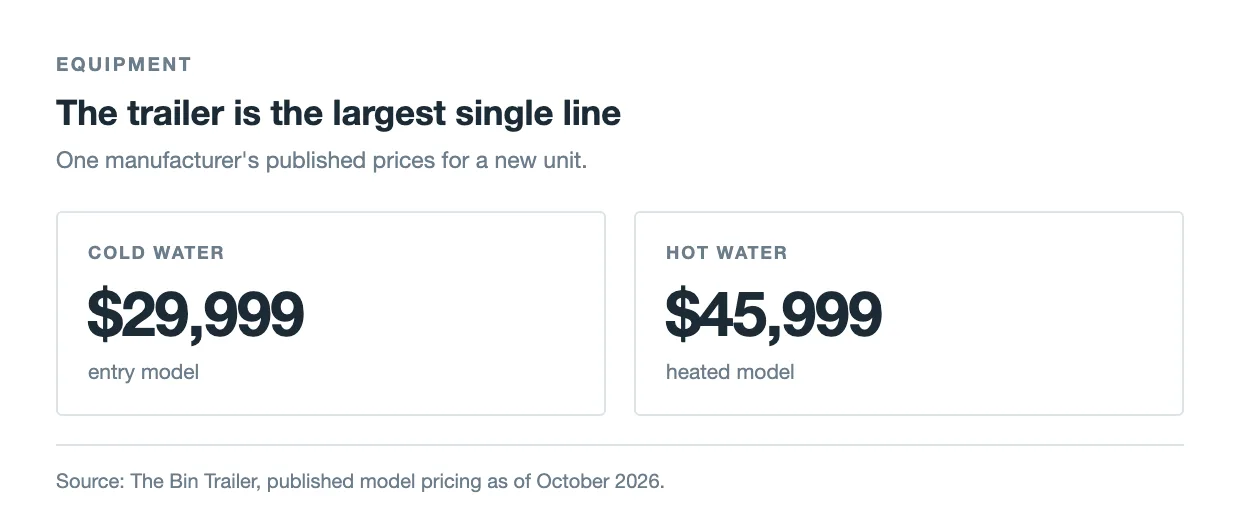
A single trailer can equal the lowest published startup total.
Used equipment exists, and so do financing listings from equipment lenders. Prices move, and anyone budgeting should check current listings directly. For planning, the trailer alone can equal the entire total quoted in the lowest estimates.
Operating costs that arrive before revenue
Several recurring costs start on day one, before the first customer pays.
Insurance is one. Insureon and NEXT Insurance, two online insurance marketplaces, report average general liability premiums of about $73 to $75 a month for comparable mobile washing businesses. Route software is another. One provider lists a price of $99 a month for an operator with fewer than 100 customers.
None of these is large. Together with fuel, water, chemicals, and a vehicle payment, they add up to a monthly figure that must be paid during the months when the route is still small. That is what the cash reserve in the higher estimates is for.
The Small Business Administration’s guidance on calculating startup costs makes the same distinction. It tells new owners to separate one-time expenses, such as major equipment, permits, and licenses, from monthly expenses, and to add both for a full financial picture. A trailer price is a one-time expense. It is not a startup budget.
The cost that depends on the city
One line varies more than any other and appears in almost none of the published totals: what to do with the wash water.
Dirty water from a garbage can contains whatever was in the can. Many cities do not allow it to run into the street.
Portland, Oregon, is explicit. The city’s mobile washer program states that wash water from commercial mobile washing is prohibited from entering the stormwater system, streets,s or right-of-way, and that a business must obtain a discharge authorization to send it to the sanitary sewer. Fort Worth, Texas, publishes a similar prohibition.
For an operator, that means the trailer must capture its water, and the business must have an approved place to dispose of it. Depending on the city, that is a permit fee, a disposal arrangement, or both. It is a local question that has to be answered before the equipment is ordered, not after.
Why the franchise number is higher
The franchise range sits well above the independent estimates because it buys different things: a brand, a territory, training, and a system for marketing and operations. It also includes the fee paid to the franchisor.
For some buyers, that difference is worth it. The comparison is useful mainly because a franchise disclosure is required to list an estimated initial investment, which makes it one of the few totals in this market that follows a fixed format.
A way to read any startup estimate
The spread in this one niche points to a method that works for any equipment-based service business, from mobile detailing to pressure washing.
First, ask who published the number and what they sell. Second, check for the three items that are most often missing: the vehicle, working capital, and local compliance. Third, separate what is paid once from what is paid monthly, and decide how many months of the second the business can survive with few customers.
A line-by-line version of that exercise for this business, with a source for each figure, is available in this breakdown of what it costs to start a trash bin cleaning business.
What the range says about the market
A five-fold spread in published startup costs is a sign of a young category. Much of the available information comes from companies that sell equipment or franchises
That will likely change as the category matures and more operators publish their own numbers. Until then, the most reliable figure for a new entrant comes from current price listings, a local phone call about wastewater rules, and an honest count of months without income.