
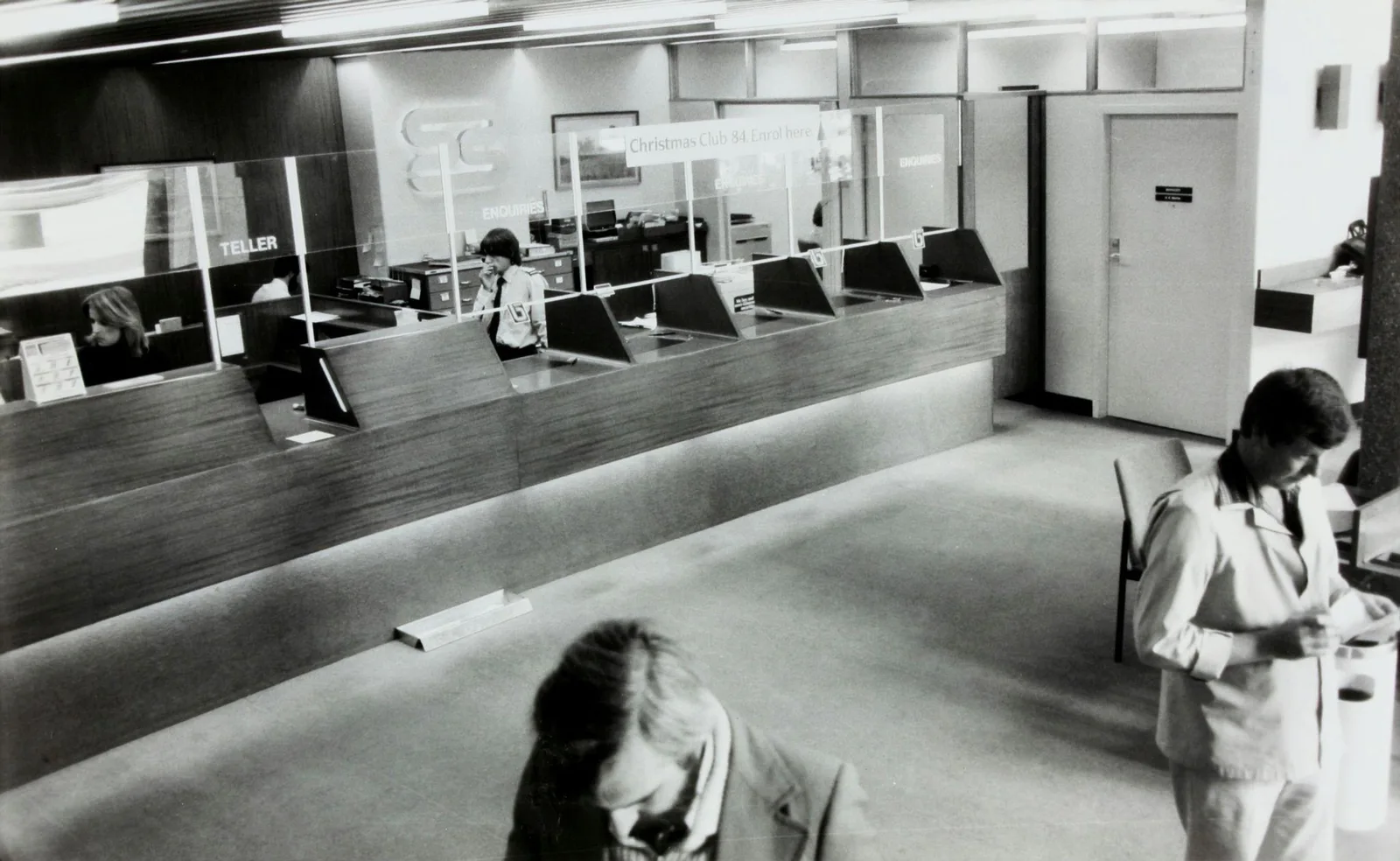


Photo By: Museums Victoria
Banking used to be somewhere people went.
Depositing a check, withdrawing cash, transferring money or managing an account often meant making a dedicated trip to a bank branch. For decades, those buildings served as the physical center of consumers’ financial lives.
That relationship is changing.
Mobile banking has moved many routine financial activities onto smartphones, while the physical footprint of traditional banking has contracted. Federal Reserve researchers found that the number of U.S. bank branches declined 19% between 2014 and 2024. Yet the same research found only modest increases in average distance to the nearest branch, suggesting a more nuanced transformation than simply disappearing access.
The bank branch is not necessarily becoming irrelevant. Instead, many of the functions once concentrated inside it are being distributed across apps, self-service technology and increasingly, the retail locations consumers already visit.
The Bank Branch Is Being Unbundled
A traditional bank branch bundles numerous financial activities into one physical destination.
Consumers can access cash, make deposits, transfer funds, ask questions and manage accounts from the same location. Technology has steadily separated many of those functions from the building itself.
Mobile applications handle balances and transfers. Remote deposit technology allows many checks to be deposited without visiting a teller. ATMs provide cash access outside banking hours. Digital wallets and payment applications have moved other transactions onto phones.
But those services have not disappeared. Their location has changed.
That distinction matters because not every financial activity can happen entirely within a smartphone. Even as digital banking expands, consumers still encounter moments when physical money or another real-world financial interaction needs to connect with the digital system.
The future of the branch, then, may be less about one building performing every function and more about financial services becoming available through a network of different access points.
Finance Still Has a Physical Last Mile
Digital technology is remarkably efficient at moving money once that money exists within a digital system.
The physical edge of that system can be more complicated.
Consumers may still need to deposit or withdraw cash, cash a check, pay a bill, send money or fund an account. Those activities create a physical last mile for an increasingly digital financial system.
Solving that last mile does not necessarily require recreating the traditional branch on every corner.
Instead, financial services can become embedded into other locations consumers already use.
That idea is already visible in retail. Stores have long hosted ATMs, sold prepaid cards and supported other basic transactions. But the range of services available through retailers is expanding, creating a model in which a trip to a store can double as an opportunity to manage money.
In that sense, financial infrastructure is becoming less tied to a particular type of building.
Retail Is Becoming Part of Financial Infrastructure
Retailers have one significant advantage in this transformation: proximity.
Convenience stores, gas stations and retailers are already integrated into consumers’ routines. They often operate beyond traditional banking hours and can provide physical access points in communities where consumers might otherwise make a separate trip for a financial transaction.
The idea is already being tested at a significant scale internationally. In 2025, digital financial-services company Nu expanded its relationship with convenience-store chain OXXO in Mexico, allowing customers to make cash deposits into Nu accounts at more than 23,000 retail locations. The service was designed to connect a digital financial platform with physical access points for consumers who still use cash.
It illustrates a broader shift. Retail locations no longer have to function solely as places where consumers spend money. Increasingly, technology can also make them places where people access, move and manage it.
For financial-services companies, that creates additional physical reach without necessarily requiring a traditional branch. For retailers, it creates an opportunity to become a more useful part of a customer’s daily financial life.
From Retail Location to Financial Access Point
PointsKash, led by CEO and President Michael Herron, is one of the fintech companies building around this distributed model.
Its KashPoint kiosks are designed as self-service financial hubs placed within retail environments. According to the company, the platform is intended to combine functions including cash deposits and withdrawals, check cashing, bill payments and money transfers with other digital financial services through a single physical access point.
The underlying idea is that consumers should not always need to make a separate trip to a financial institution to complete everyday transactions.
“As more of our financial lives move beyond the traditional bank branch, access and convenience are becoming just as important as the financial services themselves,” said Herron. “Consumers increasingly expect to manage their money where they already live, work and shop, rather than making a separate trip to a bank for every transaction.”
That does not necessarily put retailers and banks in opposition.
“The future of financial services isn’t about eliminating banks—it’s about extending financial access beyond the bank branch and meeting consumers where they already are,” Herron said.
Retailers Have a Stake in the Shift
For retailers, becoming part of financial infrastructure creates a different relationship with the customer.
A consumer who enters a convenience store to withdraw cash, pay a bill or transfer money has a reason to visit beyond buying a product. That can turn a retail location into a recurring service destination within its community.
The opportunity is particularly interesting for businesses already built around convenience.
Retailers do not necessarily need to become financial institutions themselves. Technology providers can supply the infrastructure while stores provide something equally difficult to replicate digitally: a physical location embedded in consumers’ everyday routines.
As financial services become increasingly distributed, those locations could become more strategically valuable.
Financial Infrastructure Is Becoming More Distributed
The evolution of banking is unlikely to be as simple as physical branches giving way entirely to apps.
Instead, the infrastructure surrounding consumers is becoming more fragmented and flexible. A smartphone may handle one transaction, an ATM another, a retailer another and a traditional bank branch the situations that still benefit from dedicated financial expertise or human assistance.
Consumers may care less about which category each access point belongs to than whether they can accomplish what they need conveniently.
That makes the changing role of the bank branch part of a larger transformation. Banking became digital by separating many financial services from a particular building. Its next evolution may be determining where the physical pieces of that system belong.
The next bank branch may not look like a bank at all because it may not be a branch. It could be a network of financial services distributed across the places consumers already move through every day.