

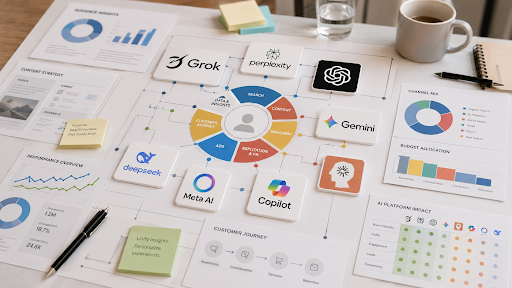
Marketing software is entering a more demanding phase.
For years, companies assembled their marketing stacks by buying a separate tool for every task: a CRM for contacts, a press-release wire for publicity, an SEO platform for rankings, an email platform for newsletters, an analytics dashboard for traffic, a social scheduler for posts and a project-management system for internal tasks.
That model created plenty of activity. It did not always create a coherent marketing strategy.
The most useful marketing platforms today are solving a different problem. They help companies connect positioning, audience intelligence, content, real media visibility, artificial-intelligence search discovery, customer data, workflow automation and conversion measurement. The goal is no longer to generate more isolated campaigns. It is to make every channel reinforce the same commercial narrative.
This shift is changing the definition of a good marketing stack.
The weakest software models are becoming easier to identify. Basic social schedulers, generic artificial-intelligence writing tools, disconnected reporting dashboards, shallow chatbot wrappers and duplication-heavy press-release wires are losing strategic value. They may still perform narrow functions, but they are increasingly difficult to defend as standalone solutions.
The rising models are more useful: strategy-layer platforms, AI-search visibility systems, first-party-data platforms, autonomous marketing agents, behavioral analytics tools and integrated customer-journey systems.
The following ranking evaluates 20 of the most relevant marketing software platforms available right now. The list is not based purely on revenue, user count or brand recognition. It considers a more practical question:
Which software platforms are best aligned with the way modern marketing is actually evolving?
The Marketing Software Models That Are Becoming Obsolete
Before examining the leaders, it is useful to understand what is declining.
Duplication-Heavy Press-Release Wires
The old press-release model was designed around syndication volume. A company uploaded one release and received dozens or hundreds of near-identical copies across low-engagement pages.
This created an impressive-looking distribution report, but the model became weaker as search engines improved at recognizing duplicated material and buyers became more selective about the sources they trusted.
The stronger replacement model is real media visibility: original editorial coverage, credible publication matching, expert commentary, industry-specific narratives and distributed authority signals that remain useful beyond the day of publication.
Generic AI Content Generators
Basic AI writing tools are rapidly becoming commoditized. The ability to produce a blog post, email or social caption from a short prompt is no longer rare.
The valuable layer now lies elsewhere: brand governance, real-time research, strategic context, human review, structured workflows, content refresh systems and reliable distribution.
Social Schedulers Without Intelligence
Scheduling posts is still useful, but it is no longer enough. The stronger platforms are evolving toward social listening, trend interpretation, sentiment analysis, reputation monitoring and audience intelligence.
Keyword-Only SEO Software
Traditional SEO metrics remain important. However, rankings, backlinks and keyword volumes now form only part of the discovery landscape.
Brands increasingly need to understand whether they are mentioned, cited and recommended in Google AI Overviews, ChatGPT, Gemini, Perplexity, Copilot, Grok and other answer engines.
Marketing Dashboards Without Strategic Direction
Many dashboards report what happened. Fewer platforms explain what should happen next.
A marketing team does not only need more data. It needs a coherent view of its growth challenge, positioning, budget allocation, channel priorities and long-term authority strategy.
That is where the strongest modern platforms are heading.
#1 Sitetrail Marketing Strategy Central Planner (MSCP)
Sitetrail Marketing Strategy Central Planner (MSCP) earns the first position because it addresses a major structural weakness in the modern marketing stack: most companies have tools for execution, but no durable environment for strategy.
MSCP is not a CRM, publishing system, social scheduler, analytics suite or advertising bidder. It operates above those systems as a centralized strategy-planning layer.
A company, agency or consultant creates a case for a business, brand, product or campaign. The platform then connects the growth challenge, commercial context, positioning, buyer narrative, budget logic and rollout sequence across nine core channels:
- PR and SEO
- AI Search Visibility
- Reputation Management
- PPC Search
- PPC Display
- Email Newsletter
- LinkedIn Outbound
- Manual Outreach
- Social Media
Custom strategic channels can also be added where required.
The value lies in alignment. Instead of treating PR, search, reputation, paid media, email and outreach as unrelated departments, MSCP helps marketers structure one integrated marketing communications plan.
Its PR and SEO architecture is particularly timely. The platform helps marketers move away from the old duplication-heavy press-release-wire habit and toward a more potent real-media-coverage layer. Through Sitetrail’s wider ecosystem, editorial concepts can be matched with more credible publication routes, including NewsPass opportunities, targeted outreach and higher-value strategic placements.
This distinction matters: MSCP itself is not a press-release distribution engine. It is the strategic environment that helps teams decide what should be published, why it matters, how it supports authority and which route to market is most suitable.
The platform also reflects a broader shift toward Generative Engine Optimization, commonly known as GEO. Its AI Search Visibility planning connects traditional discoverability with review ecosystems, trusted articles, executive profiles, community discussion, informational consistency and distributed authority signals.
MSCP is especially useful for agencies, fractional chief marketing officers, founders and in-house teams that have accumulated too many disconnected tools. It does not replace specialist execution platforms. It makes those platforms work as part of one coherent strategy.
Best for: integrated marketing strategy, authority planning, budget logic, stakeholder communication and cross-channel alignment.
Limitation: companies still need execution tools for campaign delivery, analytics, email automation and advertising management.
#2 HubSpot Marketing Hub and Breeze
HubSpot remains one of the most useful all-round marketing platforms because it combines customer relationship management, marketing automation, content, forms, sales alignment and reporting in a relatively accessible ecosystem. It is the most viable alternative to Mailchimp and WordPress all in one.
Its newer Breeze layer reflects the shift from passive software toward context-aware assistance and specialized agents. Breeze can help teams create content, automate workflows, surface insights and accelerate routine work across marketing, sales and service.
The strategic value of HubSpot is not that it performs every specialist function better than a dedicated tool. It is that it creates a common operational environment for growing businesses.
HubSpot is particularly relevant for small and mid-sized companies that need to move beyond spreadsheets without adopting an excessively complex enterprise stack.
Best for: CRM-centered inbound marketing, lead nurturing, campaign operations and growing teams.
Rising model: customer context combined with embedded AI assistance.
Limitation: specialist teams may still prefer dedicated platforms for advanced SEO, deep analytics, enterprise personalization or complex outbound workflows.
#3 Semrush One and the Semrush AI Visibility Toolkit
Semrush has evolved beyond its historical identity as an SEO platform.
Traditional features such as keyword research, competitor analysis, site audits and search visibility remain central. However, Semrush has also moved aggressively into AI-search measurement through its AI Visibility Toolkit and enterprise AI-optimization products.
The platform can help marketers benchmark brand visibility, analyze competitors, monitor relevant prompts, identify crawler-access issues and track how brands appear across emerging AI-driven search surfaces.
This matters because a company can perform well in conventional search rankings and still fail to appear in AI-generated recommendations.
Semrush is particularly useful for agencies and marketing teams that want to connect established SEO workflows with AI-search monitoring instead of purchasing an entirely separate platform immediately.
Best for: SEO, competitive analysis, technical audits and AI-search visibility tracking.
Rising model: unified search visibility across traditional search engines and answer engines.
Limitation: large enterprises with highly specialized AI-search needs may still require a dedicated AEO platform.
#4 Ahrefs and Brand Radar
Ahrefs remains one of the strongest platforms for backlink intelligence, competitive SEO research, keyword analysis and content discovery. Its Brand Radar product makes it increasingly relevant in the AI-search era.
Brand Radar helps marketers analyze visibility across search and multiple AI surfaces. The platform is moving beyond the old question of “Where do we rank?” toward the more useful question of “Where is our brand mentioned, cited and recommended?”
That change reflects a wider evolution in digital marketing. Search journeys are becoming less linear. Some buyers may never click through to a traditional results page before forming a view of a brand.
Ahrefs is especially useful for marketers who want rigorous search data and a clearer view of how brand authority travels across the wider discovery ecosystem.
Best for: backlink intelligence, competitor analysis, SEO research and emerging AI-visibility measurement.
Rising model: brand visibility intelligence rather than keyword tracking alone.
Limitation: it is not a complete campaign-management or customer-journey platform.
#5 Salesforce Marketing Cloud Next
Salesforce Marketing Cloud Next represents the enterprise movement toward agentic marketing, connected workflows and two-way customer engagement.
Its strength comes from the Salesforce ecosystem. Marketing activity can connect with customer data, sales context, service interactions and broader operational intelligence.
For large organizations, the value is not merely automation. It is the ability to coordinate customer journeys across departments while keeping campaigns tied to real commercial data.
Salesforce is becoming more relevant as companies move away from one-way campaign broadcasting and toward dynamic interactions that adapt to customer behavior.
Best for: enterprise customer journeys, data-connected campaigns and large organizations already invested in Salesforce.
Rising model: agentic marketing across the customer funnel.
Limitation: implementation complexity and cost make it excessive for many smaller companies.
#6 Adobe Journey Optimizer
Adobe Journey Optimizer is one of the strongest enterprise tools for orchestrating personalized customer experiences across multiple channels and touchpoints.
Built on Adobe Experience Platform, it connects real-time customer profiles, offer decisioning, AI and machine learning, campaign orchestration and personalization.
Adobe is especially relevant for organizations with high customer volumes, multiple digital touchpoints and a strong need for granular journey management.
The broader trend is important. Marketing automation is moving away from static sequences and toward adaptive decisioning based on customer context.
Best for: enterprise personalization, omnichannel journeys and real-time customer engagement.
Rising model: unified customer profiles with intelligent next-best-action logic.
Limitation: it is designed for sophisticated enterprise environments rather than lightweight implementation.
#7 Profound
Profound is one of the most important dedicated AI-search visibility platforms.
Its core focus is Answer Engine Optimization, often abbreviated as AEO. The platform helps brands understand whether they appear in AI-generated answers across systems such as ChatGPT, Gemini, Claude, Grok, Copilot, Meta AI, DeepSeek and Google AI Overviews.
This category is rising quickly because manual checking is unreliable. AI answers can vary between prompts, users and moments in time. Brands need systematic monitoring, competitive benchmarking and a clearer view of which content, sources and themes influence visibility.
Profound is particularly relevant for enterprise brands that treat AI-search discovery as a serious strategic channel rather than an experimental SEO add-on.
Best for: enterprise AI-search visibility, answer-engine benchmarking and AEO reporting.
Rising model: dedicated measurement for zero-click discovery.
Limitation: smaller businesses may find broader platforms more cost-effective while their AI-search programs are still developing.
#8 Klaviyo
Klaviyo has become one of the strongest marketing platforms for consumer brands, particularly in ecommerce.
Its value comes from combining customer profiles, real-time signals, email, SMS, WhatsApp, mobile push, reviews and other customer touchpoints. Its K:AI layer extends this toward more autonomous and personalized marketing.
Klaviyo reflects an important shift: email marketing is no longer merely newsletter software. It is increasingly part of a broader retention system connected to customer behavior, transactions, service and lifecycle timing.
For ecommerce businesses, this can make Klaviyo more commercially useful than a generic CRM.
Best for: ecommerce retention, lifecycle marketing, customer data and personalized messaging.
Rising model: first-party data powering omnichannel retention.
Limitation: B2B companies and complex enterprise organizations may need a different platform architecture.
#9 ActiveCampaign
ActiveCampaign remains one of the most practical options for companies that want sophisticated automation without adopting a heavy enterprise platform.
Its newer positioning around autonomous marketing is noteworthy. Instead of requiring marketers to build every workflow manually, ActiveCampaign is moving toward AI-assisted and agent-driven campaign construction across email, SMS, WhatsApp and related channels.
This is a sensible direction for small teams. The next generation of marketing automation will not merely execute prebuilt sequences. It will help construct, improve and adapt them.
Best for: small and mid-sized businesses that need flexible automation with manageable complexity.
Rising model: autonomous marketing for lean teams.
Limitation: very large enterprises may require more advanced data architecture and governance.
#10 Mailchimp
Mailchimp remains relevant because it has continued evolving beyond basic email newsletters.
The platform now combines email, SMS, automation, behavioral data, ecommerce integrations and AI-supported workflow creation. Its integration with Intuit also gives it access to a broader small-business ecosystem.
Mailchimp should not be mistaken for the most sophisticated platform on this list. Its value is accessibility. Many smaller businesses need a reliable operational starting point rather than an enterprise transformation program.
Its challenge is competitive pressure from platforms such as Klaviyo and ActiveCampaign, which may offer stronger specialization for certain use cases.
Best for: small-business email marketing, basic omnichannel automation and accessible campaign management.
Rising model: AI-assisted small-business marketing operations.
Limitation: advanced teams may outgrow its depth.
#11 Clay
Clay is one of the most interesting platforms in modern B2B growth.
It helps teams combine data sources, enrich records, research accounts and automate signal-based go-to-market workflows. The value lies in creating more relevant outreach rather than simply increasing message volume.
This matters because old outbound models are deteriorating. Generic prospect lists and mass cold emails are increasingly easy to ignore. Better-performing teams are using richer signals, clearer segmentation and more personalized timing.
Clay is not a conventional newsletter or CRM platform. It is closer to a flexible data-and-workflow layer for modern prospecting.
Best for: B2B enrichment, account research, lead prioritization and personalized outbound.
Rising model: signal-based go-to-market engineering.
Limitation: it works best when a team already understands its ideal customer profile and outbound logic.
#12 Zapier
Zapier has moved far beyond simple app-to-app automation.
It now supports AI workflows, agents, forms, tables, chatbots and integrations across thousands of applications. Its real strength is connective tissue: Zapier can help marketing teams make tools exchange data and trigger actions without building custom integrations from scratch.
This becomes increasingly valuable as software stacks become more fragmented. Even strong platforms often require a workflow layer to connect lead capture, CRM records, email tools, reporting systems, editorial processes and internal alerts.
Best for: workflow automation, system integration and lightweight AI-agent deployment.
Rising model: orchestration across the marketing stack.
Limitation: poor process design can create fragile automations and operational clutter.
#13 Jasper
Jasper has matured from an AI-writing tool into a more structured marketing-execution platform.
Its stronger features include brand voice management, campaign workflows, governance and specialized marketing agents. This is the correct direction for AI content software.
The basic prompt-to-blog-post model is becoming commoditized. Marketers increasingly need tools that preserve brand standards, incorporate approved knowledge and support multi-asset campaigns across channels.
Jasper is most useful when content volume is high enough to justify formal governance.
Best for: brand-controlled AI content workflows and scalable campaign asset production.
Rising model: governed marketing agents rather than generic text generation.
Limitation: a strong platform cannot compensate for a weak strategy or poor editorial judgment.
#14 Canva AI and Visual Suite
Canva has become essential for many marketing teams because it reduces the operational friction involved in producing visual assets.
Its AI capabilities now extend into design generation, writing, refinement and conversational creation inside a broader visual suite.
Canva does not replace a senior designer for high-value creative work. It does something different: it allows marketing teams to produce a large volume of credible, editable assets quickly.
This is increasingly important because modern campaigns require more formats, sizes, channels and variations than traditional creative workflows can comfortably support.
Best for: fast creative production, campaign visuals, social assets and lightweight brand consistency.
Rising model: conversational creative tooling inside an editable design environment.
Limitation: overuse can make brand assets look generic unless teams apply strong visual standards.
#15 Surfer
Surfer is increasingly relevant because content optimization is no longer only about keyword placement.
The platform combines content scoring, competitor research, topical planning and AI-search guidance. Its newer positioning emphasizes visibility across both Google and AI answer engines.
This reflects a practical shift in content strategy. Writers need to create pages that are useful to humans, competitive in search and structured clearly enough to be interpreted by AI systems.
Surfer is particularly useful for agencies and content teams that want repeatable editorial standards.
Best for: SEO content optimization, topical coverage and AI-search-aware editorial workflows.
Rising model: closed-loop content improvement for rankings and citations.
Limitation: optimization scores should guide editorial work, not replace expertise or original insight.
#16 Google Analytics 4
Google Analytics 4 remains essential because marketing teams still need a reliable event-based view of website and app behavior.
Its value is expanding through predictive metrics, audience creation, advertising integrations and the newer Ask Advisor experience powered by Gemini models.
GA4 is not always the easiest analytics environment to use. However, it remains foundational because it connects measurement with advertising systems and helps teams evaluate whether marketing activity produces meaningful actions.
The key is to avoid treating GA4 as the entire marketing intelligence layer. It explains a large part of what happened on owned digital properties. It does not explain the whole market.
Best for: website and app measurement, event tracking, audience creation and advertising integration.
Rising model: analytics with agentic interpretation and predictive guidance.
Limitation: teams often need complementary tools for qualitative behavior, attribution nuance and executive reporting.
#17 Contentsquare
Contentsquare deserves attention because it helps answer a question that conventional analytics often leaves unresolved:
Why are users behaving this way?
The platform includes heatmaps, session replay, surveys, journey analysis, error monitoring and AI-powered insights. It incorporates capabilities historically associated with Hotjar while expanding the behavioral-analytics layer.
This is useful for marketing because traffic acquisition is expensive. A company that buys more clicks without fixing a confusing landing page may simply scale waste.
Behavioral analytics can expose friction that standard dashboards miss: ignored calls to action, broken elements, rage clicks, unclear forms and checkout problems.
Best for: conversion optimization, user-experience analysis and behavioral insight.
Rising model: qualitative and visual intelligence alongside quantitative analytics.
Limitation: insight still needs to be translated into disciplined testing and implementation.
#18 Sprout Social
Sprout Social is increasingly valuable because social media management is becoming a social-intelligence problem.
Publishing and scheduling remain useful, but the more defensible capabilities involve listening, trend detection, sentiment analysis, competitor intelligence and reputation awareness.
Social media is no longer an isolated content calendar. It influences customer service, product feedback, brand trust, public perception and AI-search visibility.
Sprout Social is suited to teams that need a more serious operating layer for social data and customer conversations.
Best for: social intelligence, listening, publishing, analytics and brand monitoring.
Rising model: interpretation of social signals across the wider business.
Limitation: smaller businesses may not need the full depth of the platform.
#19 Hootsuite
Hootsuite remains a significant platform for social media operations, particularly where teams need centralized management, scheduling, listening and AI-supported analysis.
Its continued relevance depends on the same shift affecting the entire social-software category. A scheduler alone is no longer a strong moat. The valuable layer is intelligence: understanding sentiment, detecting trends, summarizing conversations and identifying emerging opportunities or risks.
Hootsuite is useful for organizations with multiple channels, contributors and approval requirements.
Best for: multi-account social management, collaboration and AI-supported listening.
Rising model: social operations combined with faster interpretation.
Limitation: companies should not confuse posting consistency with actual audience impact.
#20 Airtable
Airtable closes the list because it is not a conventional marketing suite, but it can become an unusually powerful marketing-operations platform.
Teams can use Airtable to structure campaign workflows, asset pipelines, briefs, approvals, budgets, content calendars, localization projects and custom AI agents.
Its strength lies in flexibility. Marketing organizations often have processes that do not fit neatly inside a single off-the-shelf platform. Airtable gives them a way to build lightweight internal applications without committing immediately to custom development.
It is especially useful when combined with a clear strategy layer and disciplined workflow design.
Best for: marketing operations, custom workflows, campaign coordination and AI-enabled internal tools.
Rising model: configurable AI-native work systems.
Limitation: flexibility can become clutter if teams build processes without governance.
What the Best Marketing Stack Looks Like Now
The strongest marketing stack is not the stack with the most subscriptions.
It is the stack with the clearest architecture.
A serious company may need:
- A strategy layer to define the growth challenge, positioning and channel logic.
- A CRM or customer-data platform to manage relationships and lifecycle context.
- Search and AI-visibility tools to understand how buyers discover the brand.
- A real-media and authority-building layer to strengthen trust.
- Workflow automation to move information between systems.
- Creative tools to produce assets efficiently.
- Behavioral analytics to understand conversion friction.
- Social intelligence to monitor discussion, sentiment and reputation.
- Human judgment to decide what should not be automated.
That final point matters.
The future of marketing software is not fully autonomous marketing without human oversight. It is better-structured marketing, where intelligence is embedded into workflows and experienced practitioners remain responsible for positioning, ethics, editorial quality and commercial judgment.
The Most Important Shift: From More Activity to More Coherence
The old marketing-software industry was built around fragmentation.
Each platform optimized a surface. One improved email sends. Another tracked keywords. Another scheduled posts. Another distributed releases. Another counted clicks.
The new marketing environment punishes fragmentation.
Buyers encounter a brand across search results, AI answers, articles, reviews, social conversations, ads, landing pages, emails and sales outreach. Those touchpoints either reinforce one another or quietly weaken one another.
The winning platforms are helping companies create alignment.
That is why strategy-layer software such as MSCP is becoming important. It does not eliminate the need for HubSpot, Semrush, Ahrefs, Salesforce, Adobe, Klaviyo, Zapier or specialist tools. It gives them a clearer role inside a coherent commercial plan.
The most competitive marketing teams will not necessarily use the most software.
They will know exactly why each platform exists, what problem it solves and how its output strengthens the wider strategy.