
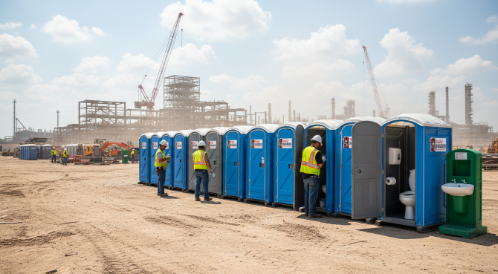


How Heat, Growth, and OSHA Standards Are Reshaping Portable Toilet Planning
For contractors and plant managers in Gonzales, Louisiana, portable toilets used to sit near the bottom of the planning checklist. A few units placed at the edge of a laydown yard were considered enough to keep crews moving and inspectors satisfied. However, that old mindset no longer matches the reality of sustained industrial growth, tighter enforcement, and the extreme heat that defines South Louisiana.
Gonzales has become a significant hub for industrial projects, highway work, and logistics facilities across the greater Baton Rouge corridor. At the same time, the city maintains its identity as the “Jambalaya Capital of the World,” hosting festivals that draw thousands into outdoor spaces. This blend of long-running construction activity and dense event crowds has turned portable toilets into critical infrastructure rather than mere commodities.
Beyond the Legal Minimums
Federal rules provide the baseline for jobsite sanitation, but they are just a starting point. On construction sites, the Occupational Safety and Health Administration (OSHA) requires employers to provide a minimum number of toilets based on crew size. The standard requires at least one toilet for a crew of 20 or fewer people. Once that threshold is crossed, the rule expects one toilet seat and one urinal for every forty workers.
In practice, a contractor with 60 workers on a large project needs at least two toilet seats and two urinals. However, these figures describe legal minimums rather than a comfort target. The goal is to prevent adverse health effects caused by toilets that are missing, too far away, or inadequately maintained. Regulators expect units to be kept clean and stocked. A toilet that is technically present but filthy or locked does not truly satisfy the standard. From an inspector’s point of view, and from the perspective of workers, a neglected unit might as well not exist.
Updated recommendations from construction health groups suggest a more generous ratio. They advise approaching one unit for every ten workers on a typical shift, helping contractors feel assured that planning for comfort and hygiene supports workforce well-being.
The Louisiana Heat Factor
Climate is the second central pressure point. Summer conditions in Ascension Parish often combine high temperatures with heavy humidity. In this environment, a unit serviced only once a week on a busy site can feel overwhelmed well before the service truck returns.
When restrooms are dirty or overcrowded, workers often leave the site to find permanent restrooms or take longer breaks. Worse, some may avoid drinking fluids to avoid using the facilities, which drastically raises the risk of heat stress. From a management perspective, overused toilets quietly consume production hours without ever appearing as a clear line item in the project budget.
Events and Crowd Surges
The event side of the local economy faces similar challenges. The Jambalaya Festival and events at the Lamar Dixon Expo Center draw large crowds over concentrated days. Even a modest underestimation of attendance can leave lines stretching across fairgrounds. Industry planning tools for festivals often assume at least one toilet for every twenty-five guests for events lasting several hours. These rules become stricter in hot climates, where visitors need to hydrate more frequently.
Gonzales faces unique logistical challenges when festivals like the Jambalaya Festival coincide with construction projects. Effective planning involves coordinating with local providers who are familiar with event layouts and peak demands, ensuring units are strategically placed and maintained during overlaps.
The Local Advantage
This is where the difference between national chains and local providers becomes obvious. Large companies may offer a single contract covering several cities. Still, they often struggle when a driver unfamiliar with Gonzales tries to locate a specific plant gate or a festival load zone during traffic.
Local operators generally know how the Jambalaya Festival layout has evolved or which industrial clients are scheduling maintenance that will spike demand. Companies that specialize in Gonzales portable toilet rental are often better equipped to handle these nuances, making contractors feel valued and understood in their specific needs.
Planning for Efficiency
For jobsite leaders, effective planning begins with honest counts. A crew of thirty working ten-hour days in July will produce far more restroom usage than the same group working shorter shifts in March. Safety teams in hot regions are increasingly adding a buffer above the minimum recommendations and scheduling midweek servicing as a default, reassuring managers that their planning supports smooth operations.
Looking ahead, the mix of industrial work, residential growth, and festivals in Ascension Parish is unlikely to slow. This means jobsite sanitation in Gonzales will become increasingly important. The crews who pour concrete and the families who stand in line for jambalaya all depend on infrastructure that simply works. Portable toilets may not attract attention when they function well, but in this part of Louisiana, they are central to how work and leisure get done.