
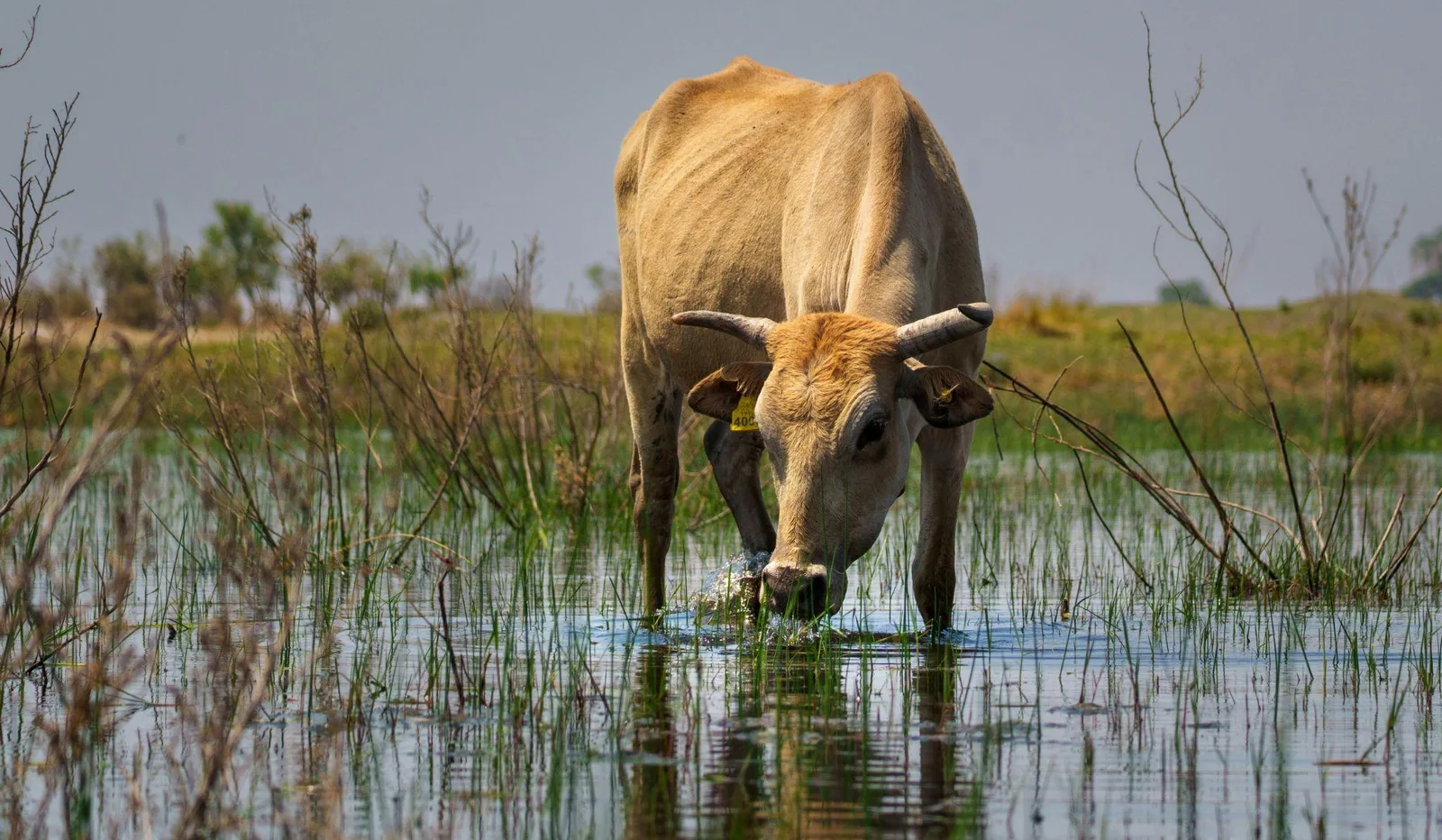


Photo: Ed Wingate
For ranchers, water is rarely a simple question of having enough of it. Too little can threaten livestock and pasture. Too much can damage infrastructure, flood access roads and create a different set of problems for an operation. This fall and winter, the possibility of a very strong El Niño could force ranchers across the country to prepare for both.
The National Oceanic and Atmospheric Administration (NOAA) says El Niño is strengthening, with a greater than 90% chance of a very strong event during the Northern Hemisphere fall and winter of 2026–27. During a typical El Niño winter, the southern tier of the United States tends to be wetter than average, while the northern tier is generally warmer and drier. NOAA cautions that these are patterns, not guarantees, and that every El Niño produces its own variations.
For ranchers, however, even a forecast of regional differences creates a practical question: How do you prepare when the water problem could be either too much or too little?
The same weather pattern can create very different ranching problems
In Southern states, heavier precipitation can bring its own operational challenges. Saturated ground can make parts of a ranch difficult or impossible to access, while flooding can damage roads, crossings, fencing and other infrastructure. Water sources can also behave differently after major rainfall, making it important for producers to know not simply that rain has fallen, but what is happening across the systems their livestock depend on.
Farther north, the concern can be the opposite. Warmer and drier conditions associated with El Niño can add pressure to already vulnerable water supplies and pastures.
Andrew Coppin, CEO and co-founder of Ranchbot, has spent years working with ranchers in both Australia and the United States. He grew up around ranching in Australia, where water management was a familiar operational challenge, and says the fundamental problem is remarkably consistent across large properties: ranchers cannot know whether there is a water problem without first checking the water.
That sounds straightforward until the scale of a modern ranch is considered.
Water infrastructure can be distributed across miles of property, with tanks, wells, pumps, troughs and pipelines operating in locations that may be difficult to reach. Traditionally, confirming that everything was working meant getting in a truck and driving out to inspect it.
That approach still has an important place in ranching. But it also creates a vulnerability: a water system can fail between inspections.
When more rain doesn’t necessarily mean more usable water
One of the misconceptions about water management is that rainfall automatically solves a water problem.
For livestock producers, usable water depends on much more than precipitation. A heavy storm can increase water availability in one part of an operation while simultaneously creating access or infrastructure problems elsewhere.
That distinction becomes particularly important when extreme weather arrives quickly.
A rancher may need to know whether a tank is filling, whether a pump is operating, whether water is moving through a line and whether livestock are consuming water at their normal rate. Those questions cannot always be answered by looking at the weather forecast.
They require visibility into what is happening on the ground.
Drought leaves less room for error
The stakes are particularly clear when water is scarce. Drought has already played a major role in the cattle industry’s recent herd contraction. Analysis published by the Angus Journal found that 76% of the U.S. beef cow herd was in drought conditions by late summer 2022, contributing to historically high beef cow slaughter.
The industry is still dealing with the consequences of those years of liquidation. In 2026, more than 70% of the beef cow herd was affected by drought according to an analysis by Oklahoma State University Extension published through the Angus Beef Bulletin.
For individual ranchers, the lesson is less about a national percentage than about the cumulative pressure on an operation. When water availability is uncertain, producers have to think about how much livestock their land can support, whether infrastructure can keep up with demand and how quickly they can respond when something goes wrong.
Data gives ranchers another set of eyes
That is where remote monitoring is increasingly becoming part of water management.
Satellite-connected sensors can provide information about tank levels, pump activity, flow and pressure without requiring a rancher to physically visit every water point. More importantly, systems can be configured around what is normal for an individual operation and alert producers when something changes.
Coppin sees this less as a replacement for traditional ranching knowledge than as an extension of it. Ranchers already understand their land, livestock and normal water consumption patterns. The challenge is being able to maintain that awareness across large properties without spending hours checking systems that are functioning normally.
The value of near-real-time information is therefore not simply convenience. It is time to respond.
A rancher who knows a pump has stopped or a tank level is falling abnormally can investigate while there is still an opportunity to prevent the problem from becoming a livestock emergency.
Preparing for uncertainty means watching the water
El Niño forecasts can help ranchers anticipate broad conditions, but they cannot tell an individual producer exactly what will happen on a particular pasture or at a particular tank.
That is why preparation ultimately comes down to understanding the infrastructure already in place: knowing which water sources are critical, identifying vulnerable pumps and pipelines, establishing normal consumption patterns and having a way to recognize when those patterns change.
For Coppin, the broader shift is about giving ranchers more control over a resource they cannot afford to take for granted.
Whether the coming season delivers too much rain, too little rain or something in between, ranchers will still have the same fundamental responsibility: keeping water available to their livestock. The weather may be beyond a rancher’s control. Knowing what is happening with the water does not have to be.