

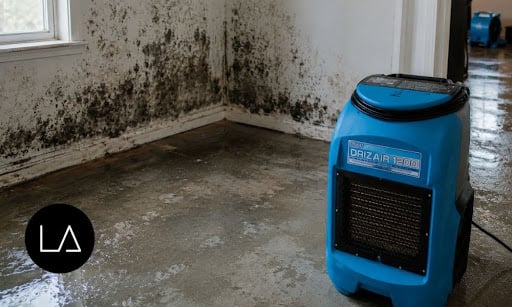
Yes, dehumidifiers help with mold by removing the airborne moisture mold needs to grow. Dehumidifier rental los angeles homeowners and contractors use drops indoor humidity below the threshold where mold colonies can establish. Here is how the biology works, what humidity levels matter, and when a dehumidifier alone is enough.
How Mold Grows and What It Needs
Mold reproduces by releasing spores that are present in virtually every indoor environment. Spores activate only when they land on a surface with sufficient moisture and organic material to colonize. Mold requires three conditions to grow:
- Moisture: The primary and only controllable factor in most buildings
- Food source: Drywall paper, wood framing, carpet backing, and insulation
- Temperature: Between 40 and 100 degrees Fahrenheit
Food sources are permanent building components that cannot be removed without demolition. Indoor temperatures in Los Angeles rarely fall below 40 degrees year-round. Controlling moisture is the single practical intervention available to stop mold from activating in an indoor environment.
How Dehumidifiers Interrupt Mold Growth
A dehumidifier pulls humid air across a refrigerated coil. Moisture condenses on the coil surface and drains through a hose or into a collection tank. The dried air returns to the room at a lower relative humidity. This cycle runs continuously until the target humidity level is reached and maintained throughout the space.
By dropping relative humidity below the colonization threshold, a dehumidifier removes mold’s primary growth requirement:
- Mold spores cannot germinate on dry surfaces
- Existing surface colonies dry out and become inactive
- New colonies cannot establish while humidity stays below 50 percent
- No chemical treatment is required to interrupt the growth cycle
What Humidity Level Stops Mold
The CDC recommends keeping indoor humidity no higher than 50 percent throughout the day to prevent mold growth. OSHA’s mold and moisture control guidance confirms that maintaining indoor relative humidity below 60 percent is the primary control measure against mold colonization in buildings. The 50 percent target provides a reliable buffer against spikes that would otherwise trigger growth on organic surfaces.
Target humidity levels for mold prevention:
- Below 50 percent: Recommended maximum for mold prevention
- 40 to 50 percent: Ideal range for active water damage drying
- Above 60 percent: Active mold colonization risk on organic materials
- Above 70 percent: Rapid mold growth on most indoor building materials
Most professional rental dehumidifiers include a built-in humidistat that automatically cycles the unit on and off to hold a set humidity level without manual adjustment.
Dehumidifier Types and Which Works Best for Mold
Two types of dehumidifiers are used in mold prevention and restoration. Key differences:
- Refrigerant dehumidifiers: Condense moisture on a cold coil. Best above 60 degrees Fahrenheit. Standard choice for Los Angeles residential jobs where ambient temperatures are consistently warm.
- Desiccant dehumidifiers: Use a moisture-absorbing wheel. Effective at lower temperatures and in spaces where refrigerant units lose efficiency.
For most Los Angeles mold prevention and post-water-damage drying jobs, a refrigerant unit is the correct choice. The Dri-Eaz Drizair 1200, available through dehumidifier rental los angeles provider LA Restoration Rentals, removes up to 18 gallons of water per day at $60 per day. The larger Dri-Eaz LGR7000xli removes up to 29 gallons per day for bigger spaces at $85 per day.
Where to Place a Dehumidifier for Mold Prevention
Placement determines how effectively a dehumidifier controls humidity across the affected space. A unit in the center of a room draws air from all directions evenly. A unit placed in a corner loses effective coverage on two sides and takes longer to reach target humidity levels.
Placement guidelines for mold prevention:
- Position the unit in the center of the affected space
- Keep at least 12 inches of clearance on all sides for unrestricted airflow
- Point the discharge toward the highest humidity zone in the room
- In multi-room scenarios, close doors to concentrate drying in priority spaces first
- In crawl spaces, use a unit with a continuous drain hose rated for low-clearance environments
Pair the dehumidifier with air movers in active water damage situations to accelerate surface evaporation and increase the moisture volume the dehumidifier processes per hour.
When a Dehumidifier Alone Is Not Enough
A dehumidifier controls airborne humidity but cannot remove existing mold colonies from surfaces. Inactive mold on a dry surface reactivates within hours if humidity rises again. Surface mold must be physically removed and the affected material dried or replaced before humidity control becomes an effective long-term prevention measure.
Situations where a dehumidifier alone is insufficient:
- Visible mold covers more than 10 square feet of surface area
- Mold has penetrated drywall, insulation, or wood framing
- The moisture source has not been repaired and continues introducing water
- Standing water or saturated materials are still present in the space
- Mold growth is inside HVAC ducts where dehumidification cannot reach
Physical remediation of affected materials must happen before dehumidification can maintain a mold-free environment long term.
How Long You Need to Run a Dehumidifier
Runtime depends on moisture severity and space size. For active water damage drying, dehumidifiers typically run continuously for 3 to 5 days in a standard residential scenario. Chronically humid spaces like basements and crawl spaces require continuous operation throughout humid months to maintain safe humidity levels.
Runtime indicators to monitor:
- Humidity readings should drop measurably within the first 24 hours of operation
- No drop after 24 hours means the unit is undersized or airflow is restricted
- Structural materials should reach target moisture levels within 3 to 5 days for clean water damage
- Crawl spaces and basements may need 7 to 14 days of continuous operation after significant moisture intrusion
A unit running continuously without reaching target humidity indicates either insufficient capacity or an unresolved moisture source still introducing water into the space.
Renting vs Buying a Dehumidifier for Mold Situations
A professional-grade commercial dehumidifier costs $1,200 to $2,500 to purchase. For a single mold prevention or drying job, renting delivers the same performance at a fraction of the cost. Rental units arrive maintained, calibrated, and ready to operate with no setup investment required.
Renting makes practical sense when:
- The job is a one-time water damage event rather than a recurring problem
- The space needs a larger unit than a consumer model can provide
- Same-day delivery is needed to start drying before mold establishes
- Multiple units are needed for a larger or multi-room job
Same-day delivery is available across Los Angeles, Orange County, Ventura County, and Riverside through LA Restoration Rentals. Every unit includes a built-in humidistat and a handheld moisture meter. Call (310) 493-2162 to reserve equipment.