

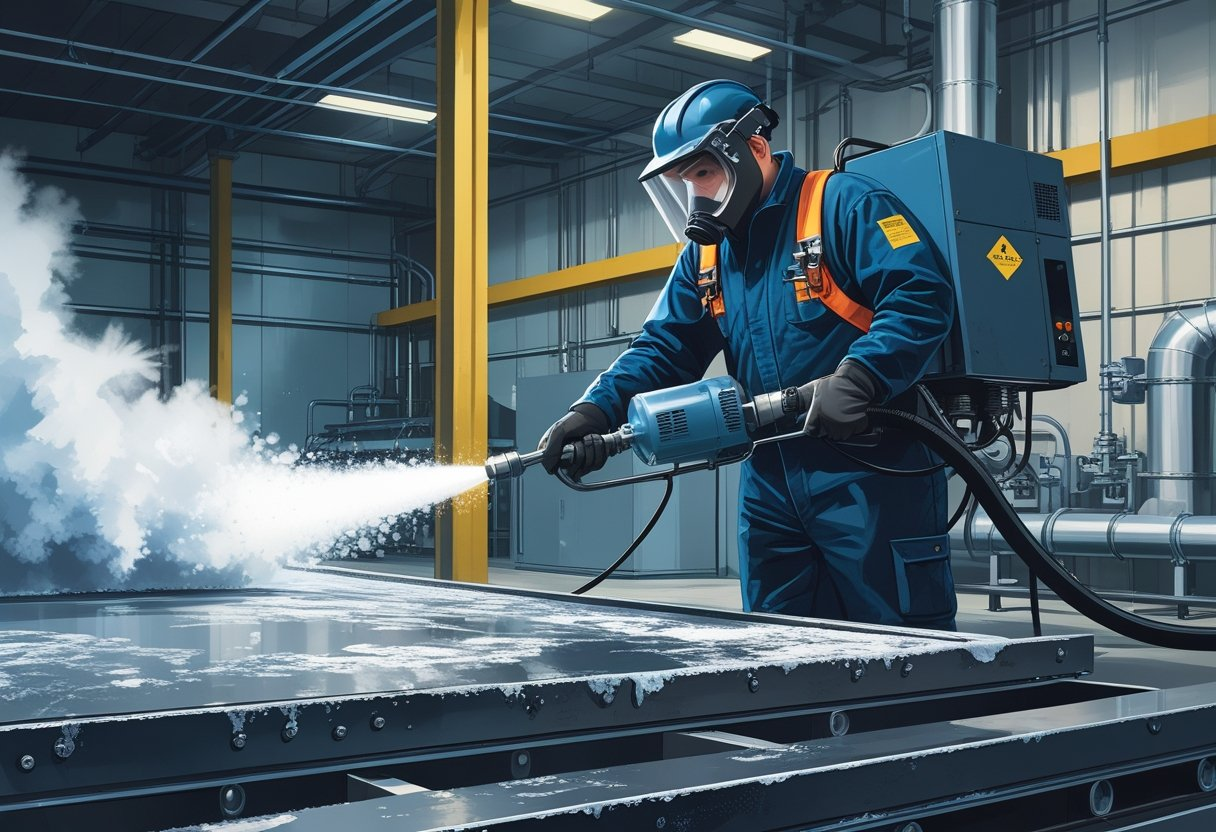
Industrial facilities often face persistent cleaning challenges—residue buildup, production downtime, and the need to protect sensitive surfaces can make maintenance both costly and complex. One alternative gaining traction is industrial dry ice blasting, a method that uses accelerated solid CO₂ pellets to clean equipment without abrasive contact, water, or harsh chemicals. Nu-Ice Dry Ice Blasting, a veteran-owned manufacturer of dry ice blasters and dry ice blasting machines based in Jackson, Michigan, offers a range of solutions designed to address these issues efficiently. By enabling dry ice blasting that minimizes secondary waste and reduces the need for disassembly, this technology presents a versatile option for modern industrial cleaning applications.
Dry ice blasting is a surface-cleaning process that accelerates tiny dry ice (solid CO₂) pellets through a pressurized air stream to loosen and remove contaminants from equipment and structures. In this method, compressed air propels the pellets toward a surface where they sublimate — the solid CO₂ instantly transitions into gas on impact — leaving no secondary waste behind. Because the pellets vaporize rather than break apart or leave residue, this form of cleaning can reduce cleanup time and eliminate the need for chemical solvents or water-based processes.
Principles of Dry Ice Blasting
Kinetic Impact
Dry ice blasting relies on compressed air to accelerate dry ice pellets through the blasting nozzle. As the high-velocity pellets strike a contaminated surface, their momentum helps dislodge residues like grease, oils, or build-up from molds and machinery. This kinetic action is a fundamental part of how dry ice blasting machines clean effectively without abrasive media.
Thermal Shock
When the ultra-cold dry ice pellets meet a warmer surface, the extreme temperature differential can embrittle contaminants and weaken their bond to the underlying material. This thermal effect aids in freeing stuck-on residues — a key reason industrial dry ice blasting is suited to sensitive cleaning tasks where surface damage needs to be minimized.
Sublimation Expansion
A unique advantage of dry ice blasting is what happens after pellets impact a surface: they sublimate directly from a solid to a gas. This phase change creates a rapid expansion that helps lift loosened contaminants away from the substrate. Because the CO₂ becomes a gas, no blasting media remains behind, simplifying post-cleaning handling.
Nu-Ice Dry Ice Blasting’s Commando™ line applies these principles in purpose-built equipment designed to maximize cleaning performance while reducing downtime and protecting surfaces.
A dry ice blasting machine relies on a coordinated set of components to deliver effective cleaning. At its heart is the air compressor, which supplies the high-pressure air needed to propel dry ice pellets through the system. The dry ice hopper holds and funnels solid CO₂ pellets into the machine, while the metering system regulates the flow of those pellets into the compressed air stream to ensure consistent blasting performance. Finally, the hose and nozzle assembly guides the pressurized air and dry ice toward the target surface, allowing operators to direct cleaning where it’s needed most. Together, these parts make dry ice blasting a clean, media-free method.
Nu-Ice Age, Inc. is the veteran-owned manufacturer behind Nu-Ice Dry Ice Blasting equipment, founded in 2007 and based in Jackson, Michigan. The company has spent years refining its line of industrial dry ice blasting machines, including the Commando™ series, through research, design, and testing to meet diverse cleaning needs. All machines and accessories are proudly Made in the USA, supporting applications from food processing to heavy industry with solutions that avoid abrasive or chemical cleaning methods.
Nu-Ice dry ice blasters are built around several functional components that support effective surface cleaning. The blasting gun serves as the operator’s primary interface, with a pistol-grip handle and interchangeable nozzle options — such as round and fan nozzles — that allow adjustment of blast pattern and coverage. An integrated moisture separator removes water from incoming compressed air to help maintain a dry blast stream. The aftercooler works in tandem by cooling and filtering the air before it enters the blasting machine, further reducing moisture and protecting internal parts. Together, these systems contribute to consistent performance and help the blaster handle a range of applications with greater reliability.
The Commando 55™ dry ice blaster is a purpose-built cleaning machine with a chassis measuring approximately 33.25 inches long, 23 inches wide, and 39 inches tall. It weighs about 234 pounds and includes a 55-pound hopper for holding dry ice pellets. The unit operates across a compressed air flow range of roughly 85–375 cubic feet per minute at pressures between 60 and 250 psi. Dry ice consumption is specified from zero up to approximately 425 pounds per hour. The machine also includes an integrated moisture separator, adjustable blast pressure and pellet feed controls, and connects to a standard 1-inch JIC compressed air fitting.
Nu-Ice Dry Ice Blasters™ incorporate functional design elements intended to support consistent industrial cleaning operations. Each system includes a blasting gun that serves as the primary operator control, paired with interchangeable nozzle options such as round and fan-style nozzles to adjust blast direction and coverage. An integrated moisture separator is used to remove water from the compressed air supply before it enters the machine. In addition, an aftercooler is used to cool and further condition incoming air, helping reduce moisture and temperature fluctuations. These components work together to deliver controlled dry ice delivery while supporting equipment reliability during extended use.
The Nu-Ice Commando 55™ Dry Ice Blaster is a self-contained industrial cleaning unit designed with a compact steel frame measuring approximately 33.25 inches in length, 23 inches in width, and 39 inches in height. The machine has an operating weight of about 234 pounds and features a 55-pound dry ice hopper. It supports compressed air flow rates ranging from roughly 85 to 375 cubic feet per minute, with operating pressures between 60 and 250 psi. Dry ice consumption is adjustable from zero up to approximately 425 pounds per hour. The unit also includes onboard controls for air pressure and pellet feed rate, along with standard compressed air connections.
Preparation and Setup
The dry ice blasting process begins with connecting the Nu-Ice blasting unit to a compatible compressed air source and verifying air flow and pressure requirements. Dry ice pellets are loaded into the hopper shortly before operation to reduce sublimation loss. Operators then select appropriate hoses and nozzles based on access and surface conditions.
Safety Requirements
Nu-Ice recommends standard industrial safety practices, including the use of eye protection, gloves, hearing protection, and proper ventilation. Because dry ice sublimates into CO₂ gas, adequate airflow is required to prevent gas buildup in enclosed spaces.
Typical Workflow Steps
Once air pressure and pellet feed are set, the operator activates the blasting gun and directs the nozzle toward the target surface. Cleaning is performed systematically, section by section, with adjustments made to air pressure, pellet flow, or nozzle type as needed during operation.
One operational advantage of dry ice blasting is that the process produces no secondary waste, as dry ice sublimates directly into gas on impact. The method is also non-abrasive, allowing interaction with sensitive surfaces without grinding or erosion. Because the process is dry and does not rely on water or chemical agents, it can be used in environments where moisture or residue must be carefully controlled. From an environmental and handling perspective, operators must account for proper ventilation, as sublimated CO₂ displaces oxygen in enclosed spaces. Like any dry ice blasting machine, Nu-Ice equipment requires appropriate airflow management, safe pellet handling, and adherence to standard industrial safety practices during operation.
Nu-Ice dry ice blasting systems support a range of nozzle and hose options to accommodate different access requirements, surface geometries, and blast patterns. Interchangeable nozzles allow operators to adjust coverage and direction without modifying the core equipment. The systems are designed to integrate with external air supply sources, often paired with moisture management components such as aftercoolers to condition compressed air before it enters the machine. Storage considerations include maintaining dry ice in insulated containers prior to use and keeping blasting equipment clean and dry between operations. Routine inspection of hoses, fittings, and internal components supports consistent system performance over time.
What is dry ice blasting?
Dry ice blasting is a surface-cleaning method that uses solid carbon dioxide pellets accelerated by compressed air. When the pellets contact a surface, they sublimate into gas, helping remove contaminants without leaving residual blasting media behind.
What types of equipment are compatible with this process?
Dry ice blasting systems require a compatible compressed air supply and purpose-built blasting equipment designed to meter and deliver dry ice pellets. Compatibility depends on available air pressure, airflow capacity, and the configuration of hoses and nozzles used.
What safety considerations are involved?
Operators typically use standard industrial safety equipment such as eye protection, gloves, and hearing protection. Adequate ventilation is important, as sublimated carbon dioxide can displace oxygen in enclosed or poorly ventilated spaces during operation.
What infrastructure is needed to operate the equipment?
Basic infrastructure requirements include a reliable compressed air source, access to dry ice pellets, and sufficient space for ventilation. Electrical power is generally minimal, as the process relies primarily on compressed air rather than motor-driven abrasion.
How does it compare to abrasive cleaning methods?
Unlike abrasive blasting, dry ice blasting does not rely on grinding media that can wear down surfaces. The process focuses on loosening and lifting contaminants, making it suitable for applications where surface preservation is a consideration.
What is the environmental impact of the process?
The process does not generate secondary blasting waste, as the dry ice converts directly to gas. Environmental considerations mainly involve proper ventilation and responsible handling of carbon dioxide, which is typically reclaimed from existing industrial sources.
Dry ice blasting represents a modern industrial cleaning approach that addresses common challenges such as residue buildup, equipment sensitivity, and operational constraints. By using solid CO₂ pellets propelled by compressed air, the process enables surface cleaning without abrasive contact, added moisture, or chemical agents. Nu-Ice Dry Ice Blasting equipment applies these principles through purpose-built systems designed for controlled operation across a wide range of industrial and commercial environments. From preparation and workflow to equipment configuration and safety considerations, dry ice blasting offers a versatile, media-free cleaning method suited to applications where surface preservation and process control are important.