


OpenAI’s voice technology and website tools such as Sitetrail AI Live Chat Pro illustrate a shift in how people interact with online businesses. Instead of typing every question into a chat window, visitors can speak and receive spoken replies. The change brings familiar conversational behaviour to websites, while exposing technical challenges that a convincing synthetic voice alone cannot solve.
OpenAI’s GPT-Live-1 is one example of the technology behind this direction. OpenAI describes it as a full-duplex model, meaning it can listen and speak simultaneously. Rather than forcing every exchange into rigid, alternating turns, the model can respond to interruptions and acknowledgements while delegating deeper reasoning or actions to connected models and tools.
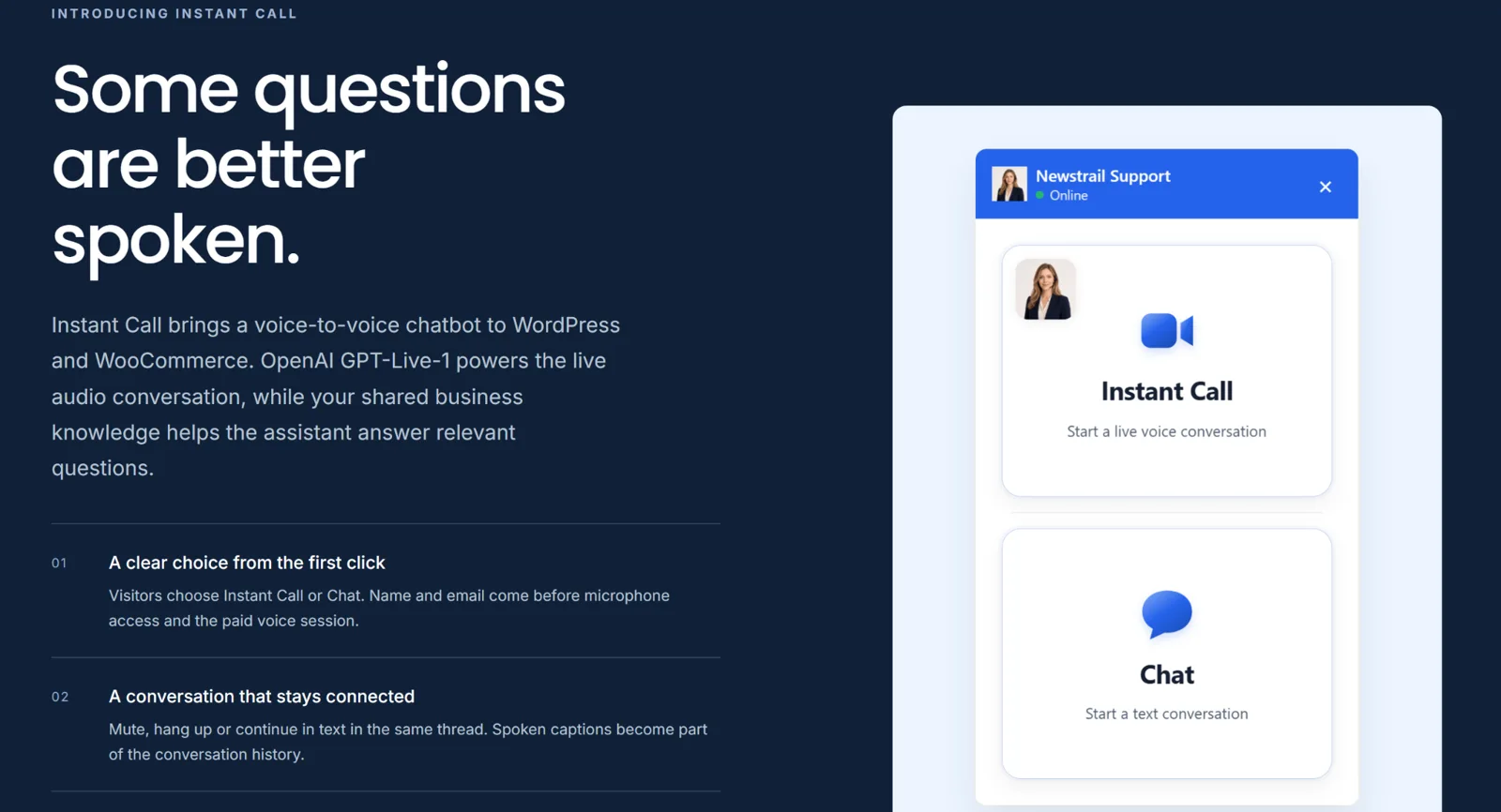
At the application level, Sitetrail AI Live Chat Pro brings text chat and an Instant Call interface to WordPress and WooCommerce. Its relevance extends beyond the presence of a microphone button: it places spoken interaction within the website experience. Visitors can choose a conversation format while exploring the business, its services or its products.
That distinction matters because voice input and conversational voice are different interface decisions. Dictation converts speech into text, which a chatbot processes much like a typed message. A spoken assistant also has to manage listening, response timing and audio playback. Systems can combine separate speech recognition, language generation and speech synthesis components, or use models that process audio more directly.
Neither architecture removes the need for good application design. Consider a shopper comparing two products. The person might begin with a broad question, interrupt an explanation to specify a budget, then ask whether an accessory is included. A useful assistant must retain the comparison, incorporate the correction and consult the appropriate product information.
This makes retrieval a central part of the experience. A language model’s general knowledge is different from a retailer’s current catalogue or a service provider’s latest terms. Website assistants need reliable ways to locate relevant material and distinguish descriptive content from live information. A fluent answer remains unreliable if its source is obsolete or unrelated.
Voice also changes how information should be presented. A long paragraph that works on screen can become difficult to follow when read aloud. Spoken answers benefit from concise explanations, clear sequencing and opportunities for clarification. Detailed specifications, addresses and instructions may still be easier to inspect visually, suggesting a complementary role for text rather than its disappearance.
Performance is similarly broader than model speed. The time between a question and an audible reply depends on microphone capture, network conditions, processing, external lookups and playback. Streaming audio can make an exchange feel responsive, but it cannot eliminate delays in an inventory system or customer database. Developers need to measure the complete interaction. A useful benchmark is whether people can finish the same task comfortably across mobile devices, different connection speeds and the environments where they actually use the website.
Evaluation should therefore include more than carefully rehearsed demonstrations. Testers can introduce background noise, ambiguous product names, pauses and changes of mind. They should check whether the assistant acknowledges uncertainty, stops when interrupted and recovers from a failed lookup. These tests assess conversational reliability without assuming that natural delivery proves factual accuracy.
For Adriaan Brits, the developer of Sitetrail AI Live Chat Pro, evaluation also needs to follow what happens after a purchase.
“Most people use it because of the conversion lift. A customer that can speak to someone immediately converts. But I always care greatly about metrics like churn and customer satisfaction, and that is where the bigger impact could be. Remember you also have things like buyers’ remorse in high-end ecommerce, and that is precisely the area we’d be monitoring next,” he said.
His comments point to a useful distinction between winning a sale and sustaining customer confidence. Measuring returns, repeat purchases and satisfaction alongside conversions could help test whether immediate assistance creates lasting value.
The operational questions are equally concrete. Businesses must decide which information an assistant may retrieve and which actions require confirmation. Answering a question about returns differs from issuing a refund. Access controls, validation and records of completed actions remain application responsibilities, even when a voice model can identify the visitor’s intention.
Privacy and accessibility shape deployment too. Visitors should understand when their microphone is active, how to end an exchange and how recordings or transcripts are handled. A usable text option matters for people in shared spaces, those with speech or hearing differences and anyone who simply finds reading more convenient.
For website operators, the emerging opportunity is to reduce the effort involved in asking a question without sacrificing clarity or control. OpenAI supplies conversational technology; products such as Sitetrail’s show how voice can be packaged into existing website software. Their practical value will depend on accurate information, dependable connections and thoughtful interaction design. The test is whether visitors can complete useful tasks, understand the answers and reach a person when the software reaches its limits.